
The Accuracy Trap: Why Almost Right Is Worse Than Wrong
Alok Mani · · 11 min read · IDP
Share: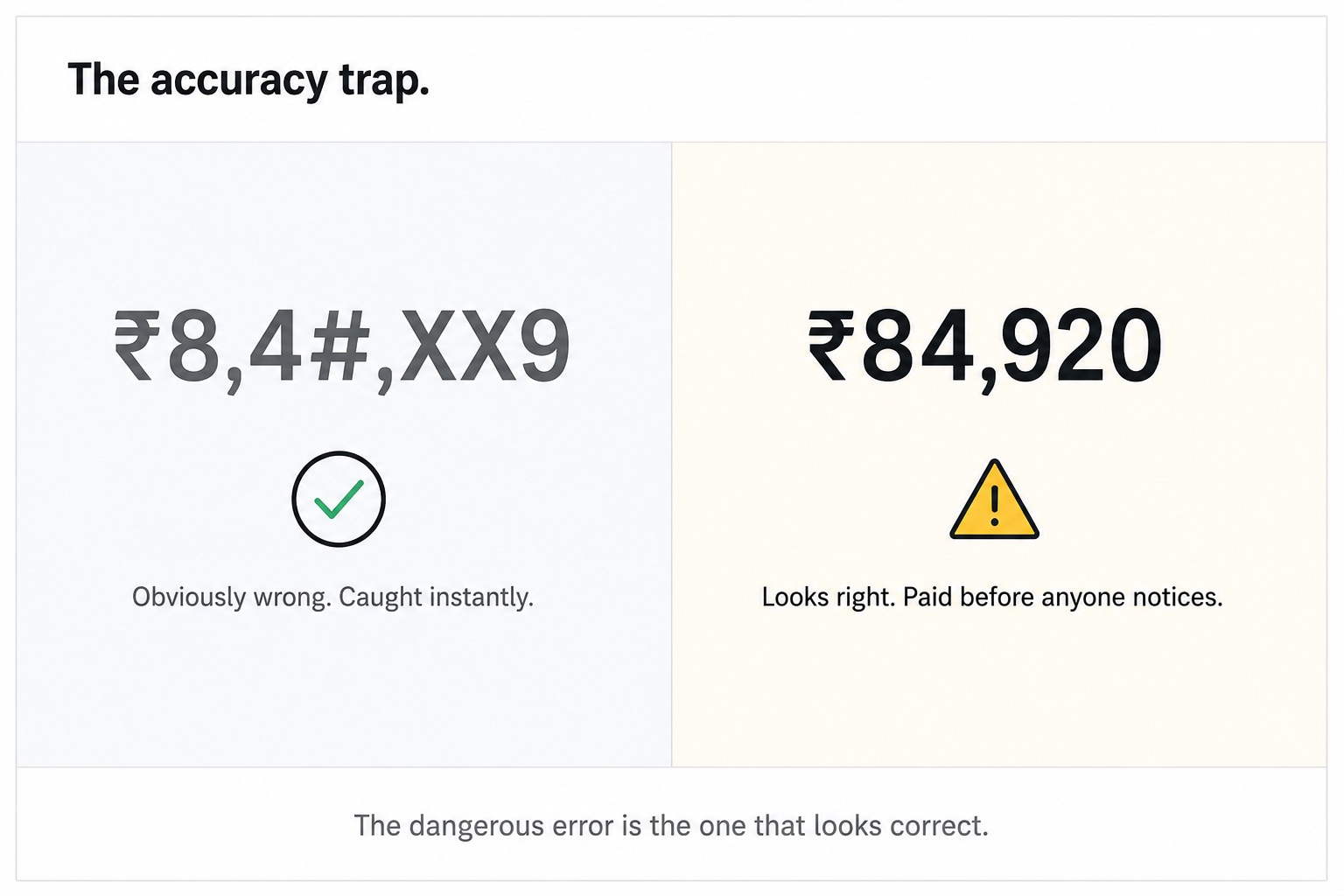
A vendor once told me their document AI was 92 percent accurate, like it was a selling point.
I asked one question back. "Which 8 percent is wrong?"
He did not have an answer. And that is the whole problem in a sentence.
If you cannot tell me which fields are wrong, then I have to check all of them. Your 92 percent accuracy did not remove my verification work. It just gave me a false sense of security while I do the same job I was doing before, slower, because now I am second-guessing a machine instead of trusting my own eyes.
This is the accuracy trap. It is the single most misunderstood idea in document automation, and it is why so many AI deployments quietly fail to deliver the savings they promised. The number on the slide goes up. The cost on the floor does not come down.
Let me walk through why "almost right" is worse than wrong, where the economics actually flip, and what number you should be asking vendors about instead of raw accuracy.
The trap: accuracy that does not reduce work
Here is the mental model most people carry. Accuracy goes from 80 to 90 to 95 percent, and the value goes up smoothly along with it. More accuracy, more savings, in a straight line.
That is not how it works. The relationship is not a line. It is a cliff.
Below a certain accuracy threshold, a human has to verify every single output. It does not matter whether the system is 70 percent accurate or 90 percent accurate. If you cannot trust any individual output without checking it, you check all of them. The verification cost is the same.
Above that threshold, the economics flip. Now you can trust most outputs and only check the ones the system flags as uncertain. The verification cost collapses. That is where the savings live.
So the value curve is flat and low across the whole range below the threshold, then jumps sharply once you cross it. Most document AI sits in the flat, useless part of the curve and calls itself automation.
This is why a finance team can buy a "90 percent accurate" tool and feel like nothing changed. Nothing did. They are still verifying everything. They just added a software licence to the cost of doing it.
Why almost-right is more dangerous than clearly wrong
There is a second, sharper edge to this trap. Not all errors are equal.
A clearly wrong output is a gift. If the system reads an invoice total as "₹8,42,XX9" with garbage in the middle, a human catches it instantly. The error announces itself. It gets fixed. No harm done.
An almost-right output is the dangerous one. If the system reads a total of ₹84,290 as ₹84,920, it looks completely plausible. There is nothing to catch. The reviewer's eye slides right past it because it looks like a normal number in a normal place. It flows into the ERP. The payment goes out. The error surfaces three weeks later when the vendor calls, and now you are doing forensic accounting to trace where ₹630 went.
The closer an error is to correct, the more expensive it becomes, because it survives review and causes downstream damage that is hard to trace back.
A garbled number gets caught in seconds. A plausible wrong number gets caught after the money has left the building.
This is the part raw accuracy numbers completely miss. Two systems can both be 95 percent accurate, but if one makes obvious errors and the other makes plausible errors, they have wildly different real-world costs. The plausible-error system is worse, even at the same accuracy, because its mistakes are the kind that slip through.
The number that actually matters: confidence calibration
So if raw accuracy is the wrong thing to optimise, what is the right thing?
Confidence calibration. The system's ability to know when it is uncertain, and to tell you.
A well-calibrated system does not just give you an answer. It gives you an answer plus an honest confidence score on that specific field. When it says "98 percent confident," it is right 98 percent of the time. When it says "60 percent confident," it flags the field for review.
This changes everything, because now the human is not checking 100 percent of outputs. The human is checking only the fields the system itself is unsure about. The certain outputs flow straight through. The uncertain ones get targeted review.
This is the insight that separates document AI that works from document AI that demos. A slightly less accurate system with honest, calibrated confidence beats a more accurate system that cannot tell you which outputs to trust. Every time.
When you evaluate a vendor, the question is not "what is your accuracy." The question is "when your system is wrong, does it know it was wrong, and does it tell me?"
This is universal, not just an invoice problem
I have used invoices as the example because that is the world I work in. But the accuracy trap is not specific to document processing. It shows up anywhere a machine produces output that a human might have to verify.
- Medical transcription. A 90 percent accurate transcription still needs a clinician to read every line, because a plausible-but-wrong dosage is a danger, not a typo.
- Code generation. AI that writes mostly-correct code that compiles but has a subtle logic bug is more dangerous than code that obviously fails, because the subtle bug ships.
- Translation. A translation that reads fluently but inverts a key meaning is worse than one that is obviously broken, because the fluent error gets trusted.
- Fraud detection. A model that flags everything with no confidence ranking forces analysts to review every alert, which is the same as having no model.
- Self-driving. The hardest problem is not the 99 percent of driving the system handles. It is whether it knows the 1 percent it cannot handle and hands back control in time.
In every one of these, the pattern is identical. Below a trust threshold, the human verifies everything and the automation adds cost without removing work. Above it, the human verifies only the flagged exceptions and the economics transform. And in every case, a calibrated "I am not sure about this one" is worth more than a marginal bump in raw accuracy.
This is one of those ideas that, once you see it, you see it everywhere. The value of an automated system is not its average accuracy. It is whether it lets you stop checking.
What this means for buying document AI
If you take one practical thing from this, let it be how you run a vendor evaluation. Most finance and operations teams ask the wrong question and get a misleading answer.
Stop asking: "What is your accuracy?"
Start asking:
- "What is your accuracy on documents you have never seen before?" Not the tuned demo. The real-world number on unseen formats.
- "Does every field come with a calibrated confidence score?" If yes, ask them to prove the calibration holds. A 95 percent confidence claim should be right 95 percent of the time.
- "What percentage of outputs can flow straight through without human review?" This is the number that maps to actual savings.
- "When the system is wrong, what kind of wrong is it?" Obvious errors or plausible ones? Plausible errors cost more even at the same accuracy.
- "How do you flag the exceptions, and how targeted is that flag?" Field-level flags with reasons, or whole-document flags that send everything back to a human?
The answers to these tell you whether you are buying automation that crosses the trust threshold, or a faster way to do the same manual work you already do.
How we think about this with DocXtract
When we built DocXtract at RPATech, we spent as much effort on confidence calibration as on raw extraction accuracy. Maybe more. Because we learned early that a high accuracy number nobody can act on is worthless.
Every field DocXtract extracts comes with a calibrated confidence score. Fields above the threshold flow straight through to the ERP or claims system. Fields below it are flagged individually, with the specific reason and the location on the document, so a human reviews exactly that field and nothing else.
In production, this is what lets our clients run 88 to 92 percent straight-through processing while a human handles only the genuinely uncertain remainder. The accuracy number matters, and ours sits at 95 to 98 percent. But the calibration is what turns that accuracy into savings instead of false confidence.
We wrote about the deeper mechanics of this in our piece on context-aware document extraction, and the full story of why we built DocXtract this way is in the build story here.
The one line to remember
Accuracy is not the product. Trust is the product.
A system you can trust to flag its own uncertainty lets you stop checking the rest. A system that is slightly more accurate but cannot tell you when it is wrong leaves you checking everything, forever.
Almost right is worse than wrong, because wrong gets caught and almost right gets paid.
Ask vendors the trust question, not the accuracy question. The gap between those two is where most automation budgets quietly disappear.
FAQ
Why is 90 percent accuracy not good enough for document automation?
At 90 percent field-level accuracy, one in ten fields is wrong, but you cannot predict which one. So a human has to check all of them. The automation extracts the data but does not remove the verification work, which is where most of the cost sits. The economics of automation only work once accuracy is high enough that you can trust most outputs without checking them.
What is the accuracy threshold where document AI becomes useful?
It varies by use case, but the practical trust threshold for straight-through processing is usually 95 to 98 percent field-level accuracy, paired with reliable confidence scoring. Below that, a human reviews everything and the automation is just faster data entry. Above it, the human only reviews the small set of low-confidence exceptions, which is where the cost savings come from.
Why is almost-right worse than clearly wrong?
A clearly wrong output is easy to catch. An almost-right output looks correct, so it slips through review and into your systems, where it causes downstream errors that are expensive to trace. A wrong total on an invoice that looks plausible is more dangerous than a garbled one, because nobody questions it until the payment has already gone out.
What is more important than raw accuracy in document AI?
Confidence calibration. A system that knows when it is uncertain and flags those specific fields is far more valuable than one with slightly higher raw accuracy but no reliable way to tell you which outputs to trust. Calibrated confidence lets you route the certain outputs straight through and send only the genuinely uncertain ones to a human.
How does DocXtract handle the accuracy trap?
DocXtract pairs high field-level accuracy with calibrated confidence scoring on every extracted field. Outputs above the confidence threshold flow straight through to your ERP. Outputs below it are flagged with the specific field and reason, so human review is targeted rather than blanket. This is what moves a deployment from faster data entry to genuine straight-through processing.